


IELTS Listening Practice Tests With Audios
Table of Contents
IELTS Listening Practice Tests Part 1: Questions 1-3
Choose the correct letter A, B or C.
1. What is Martin’s occupation?
2. The friends would prefer somewhere with
3. Phil would rather live in
Questions 4-10
Complete the table below. Write NO MORE THAN THREE WORDS AND/ OR A NUMBER for each answer.
DETAILS OF FLATS AVAILABLE
| Location | Features | Goods and bad points |
| Bridge Street, near the (4)……………….. | – 3 bedrooms – very big living room | – (5) £………..a month – transport links – no shower – could be (6)……….. |
| (7)………………….. | – 4 bedrooms – living room – (8)………… | – (9)…………….and well equipped – shower – will be (10)………… – £ 800 a month |
(4)
(5)
(6)
(7)
(8)
(9)
(10)
IELTS Listening Practice Tests Part 2: Questions 11-15
Complete the sentences below. Write NO MORE THAN THREE WORDS for each answer.
The British Library
11. The reading rooms are only open for group visits on
12. The library was officially opened in
13. All the library rooms together cover meter square.
14. The library is financed by the
15. The main function of the library is to provide resources for people doing
Questions 16-20
Label the plan below. Write NO MORE THAN THREE WORDS for each answer.
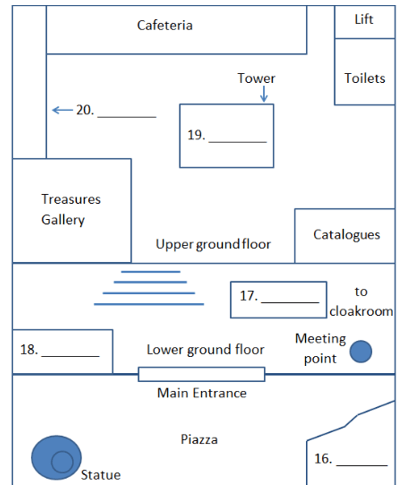
(16)
(17)
(18)
(19)
(20)
IELTS Listening Practice Tests Part 3: Questions 21-25
Choose the correct answer A. B or C
Project on work placement
21. The main aim of Dave’s project is to
22. Dave’s project is based on schemes in
23. How many academic organisations returned Dave’s questionnaire?
24. Dave wanted his questionnaires to be completed by company
25. Dr Green wants Dave to provide a full list of
Questions 26-30
Complete the notes below. Write NO MORE THAN TWO WORDS for each answer.
Notes on project
Introduction
– improve the (26) of ideas
– include a (27) of ‘Work Placement’
– have separate sections for literature survey and research (28) and methods
Findings
Preparation stage – add summary
(29) development – good
Constraints on learning – provide better links to the (30) from research
IELTS Listening Practice Tests Part 4: Questions 31-35
Complete the sentences below. Write NO MORE THAN THREE WORDS for each answer.
Bilingualism can be defined as having an equal level of communicative (31) in two or more languages.
Early research suggested that bilingualism caused problems with (32) and mental development.
Early research into bilingualism is now rejected because it did not consider the (33) backgrounds of the children
It is now thought that there is a (34) bilingualism and cognitive skills in children.
Research done by Ellen Bialystok in Canada now suggests that the effects of bilingualism also apply to (35)
Questions 36-40
Choose the correct letter A, B or C.
36. In Dr Bialystok’s experiment, the subjects had to react according to
37. The experiment demonstrated the ‘Simon effect’ because it involved a conflict between
38. The experiment shows that, compared with the monolingual subjects, the bilingual subjects
39. The results of the experiment indicate that bilingual people may be better at
40. Dr Bialystok’s first and second experiments both suggest that bilingualism may
1. B
2. A
3. C
4. BUS STATION
5. 450
6. NOISY
7. HILLS AVENUE
8. DINING ROOM
9. MODERN
10. QUIET
11. SUNDAYS
12. 1998
13. 100000
14. GOVERNMENT
15. RESEARCH
16. CONFERENCE CENTRE
17. INFORMATION DESK
18. BOOKSHOP
19. KING’S LIBRARY
20. STAMP DISPLAY
21. B
22. C
23. A
24. B
25. A
26. ORGANISATION
27. DEFINITION
28. AIMS
29. KEY SKILLS
30. EVIDENCE
31. PROFICIENCY
32. LEARNING
33. SOCIAL AND ECONOMIC
34. POSITIVE RELATION BETWEEN
35. ADULTS
36. A
37. A
38. B
39. C
40. A