


IELTS Listening Practice Tests With Audios
Table of Contents
IELTS Listening Practice Tests Part 1: Questions 1-10
Complete the form below. Write ONE WORD OR A NUMBER.
COOKERY CLASSES
| Cookery Classes | Focus | Other Information |
| The food studio | how to (1)…………and cook with seasonal products | – small classes – also offers (2)…………classes – clients who return get a (3)…………discount |
| Bond’s cookery school | food that is (4)………… | – includes recipes to strengthen your (5)………… – they have a free (6)…………every Thursday |
| The (7)…………Centre | mainly (8)…………food | – located near the (9)………… – a special course in skills with a (10)…………is sometimes available |
(1)
(2)
(3)
(4)
(5)
(6)
(7)
(8)
(9)
(10)
IELTS Listening Practice Tests Part 2: Questions 11-13
Choose the correct letter A, B or C.
Traffic Changes in Granford
11. Why are changes needed to traffic systems in Granford?
12. In a survey, local residents particularly complained about
13. According to the speaker, one problem with the new regulations will be
Questions 14-20
Label the map below. Write the correct letter A-I next to questions 14-20.
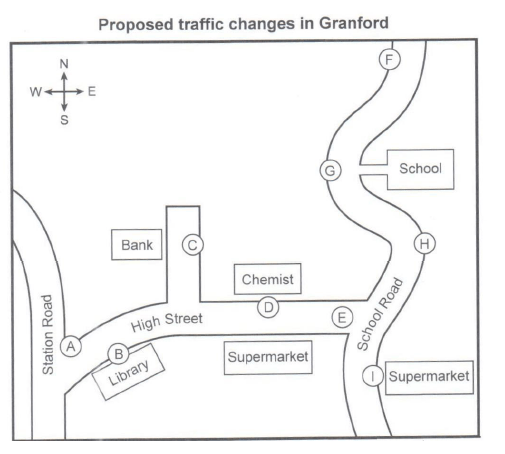
14. New traffic lights
15. Pedestrian crossing
16. Parking allowed
17. New ‘no parking’ sign
18. New disabled parking spaces
19. Widened pavement
20. Lorry loading/ unloading restrictions
IELTS Listening Practice Tests Part 3: Questions 21-25
Choose the correct letter A, B or C.
21. Why is Jack interested in investigating seed germination?
22. Jack and Emma agree the main advantage of their present experiment is that it can be
23. What do they decide to check with their tutor?
24. They agree that Grave’s book on seed germination is disappointing because
25. What does Jack say about the article on seed germination by Lee Hall?
Questions 26-30
Complete the flow chart below. Choose FIVE answers from the box and write the correct letter A-H next to questions 26-30.
| A. container | B. soil | C. weight | D. condition |
| E. height | F. colour | G. types | H. depths |
| Stages in the experiment |
| Select seeds of different (26)…………and sizes |
| Measure and record the (27)…………and size of each one |
| Decide on the (28)…………to be used |
| Use a different (29)…………for each seed and label it |
| After about 3 weeks record the plant’s (30)………… |
| Investigate the findings |
(26)
(27)
(28)
(29)
(30)
IELTS Listening Practice Tests Part 4: Questions 31-40.
Complete the notes below. Write ONE WORD ONLY for each answer.
Effects of urban environment on animals
Introduction
Recent urban developments represent massive environmental changes. It was previously thought that only a few animals were suitable for city life e.g.
• The (31) Because of its general adaptability
• The pigeon – because walls of city buildings are similar to (32)
In fact, many urban animals are adapting with unusual (33)
Recent research
• Emilie Snell-Rood studied urbanized mammal specimens from museums in Minnesota
o She found the size of their (34) had increased
o She suggests this may be due to the need to locate new sources of (35) and to deal with new dangers
• Catarina Miranda focused on the (36) of urban and rural blackbirds.
o She found urban birds were often braver but were afraid of situations that were (37)
• Jonathan Atwell studies how animals respond to urban environments
o He found that some animals respond to (38) by producing lower levels of hormones.
• Sarah Partan’s team found urban squirrels use their (39) to help them communicate
Long- term possibilities
Species of animals may develop which are unique to cities. However, some changes may not be (40)
1. CHOOSE
2. PRIVATE
3. 20%
4. HEALTHY
5. BONES
6. LECTURE
7. ARRETSA
8. VEGETARIAN
9. MARKET
10. KNIFE
11. B
12. C
13. B
14. E
15. D
16. B
17. G
18. C
19. H
20. I
21. A
22. C
23. B
24. C
25. B
26. G
27. C
28. H
29. A
30. E
31. CROW
32. CLIFFS
33. SPEED
34. BRAINS
35. FOOD
36. BEHAVIOUR
37. NEW
38. STRESS
39. TAILS
40. PERMANENT